How to Clear a Clogged Drain: The Complete Alaska Homeowner’s Guide
Standing in ankle-deep shower water again? Here’s how to clear that clogged drain — fast.
A slow sink, a gurgling tub, water that won’t go down: a clogged drain is one of those
problems that turns a normal morning into a mess in about thirty seconds. The good news
is that most clogs come out with tools and supplies you already have at home, and no
plumber is required.
This guide walks you through every method that works, from the gentlest first try to the
“okay, time to open the pipe” last resort. We’ve ordered them the way we’d tackle them
ourselves, safest and simplest first. We’ll also tell you, honestly, the moment it stops being
a DIY job because we all know, in Alaska, a small clog ignored in winter can turn into a
frozen, cracked pipe in a hurry.
In a hurry? The fastest fix for most kitchen and bathroom clogs is a good old-fashioned
plunger, followed by clearing the P-trap under the sink. Both are covered below. If your
water is backing up into multiple drains at once, skip the DIY and call us. That’s a sign of a
deeper problem.
First, what’s actually clogging your drain?
Knowing what you’re dealing with tells you which method will work — and which will make things worse.
- Hair and soap scum — the usual culprit in bathroom sinks, tubs, and showers. Responds well to a snake, a plunger, or an enzyme cleaner.
- Fat, oil, and grease (FOG) — the kitchen-sink killer. It pours in as a liquid, then cools and hardens inside your pipes. Important: hot water and baking-soda tricks only melt FOG enough to move it deeper down the line, where it re-hardens and creates a worse clog later. FOG needs dish soap and hot water, an enzyme cleaner, or professional clearing.
- Food scraps and coffee grounds that are common in kitchen drains, especially without a disposal. Coffee grounds clump; they should go in the trash or compost, not the sink.
- Mineral buildup: Alaska’s harder water can leave a scale that narrows pipes over time.
- A foreign object: a bottle cap, a kid’s toy, a wad of paper towel. No chemical clears this; it has to come out physically.
If you can identify the cause, jump to the method that fits. If you can’t, start at the top and work down.
7 ways to clear a clogged drain (in the order we’d try them)
- Boiling (or very hot) water
The simplest possible first move. Boil a kettle and pour the water down the drain in two or
three stages, giving it a few seconds between pours. For grease and soap-based clogs, this
alone sometimes does the job.
Two cautions: Don’t use boiling water on PVC or other plastic pipes. It can soften or warp
the joints. Use hot tap water instead. And remember the FOG rule above: with a grease
clog, hot water is a temporary loosener, not a cure. - The plunger
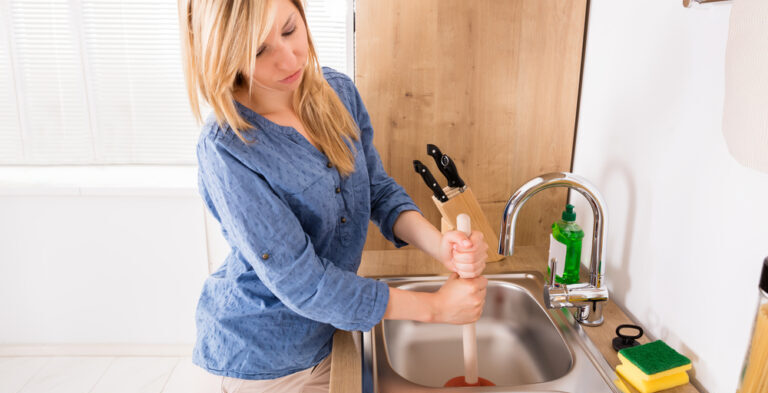
For most kitchen and bathroom sink clogs, the humble plunger is the highest-success, lowest-effort tool you own. Use a flat-bottomed cup plunger for sinks. Fill the basin with a couple of inches of water so the cup seals, block the overflow opening with a wet rag (this is what gives you real suction), and plunge firmly fifteen to twenty times. Keep a separate plunger for sinks and toilets, or clean the toilet plunger thoroughly first. - Baking soda and vinegar (and other pantry mixes)
The classic natural method. Pour hot water down the drain, then add equal parts baking soda and vinegar, baking soda first. Cover the drain with a plug and let it sit for 20–30 minutes, then flush with more hot water. Worth a frank word here: some plumbers consider this more folklore than science, because the fizzing reaction vents out the open drain instead of pushing on the clog — meaning the hot water may be doing most of the work. It’s gentle and cheap, so it’s fine as an early try, but don’t be surprised if a stubborn clog shrugs it off. A few variations on the same idea:- Baking soda and salt, pour equal parts down the drain, wait 20–30 minutes, flush with hot water.
- Salt, vinegar, and lemon: use equal parts salt and vinegar plus a splash of lemon juice; sit 20–30 minutes, then rinse with hot water.
- Salt and hot water. Use at least a half-cup of salt followed by hot water; salt’s abrasive, antiseptic action helps scour the pipe.
Avoid using baking soda in metal pipes. Over time, it can corrode the surface.
- A drain snake, auger, or bent wire hanger
When the clog is solid or sits deeper than a plunger can reach, go mechanical. Straighten a wire coat hanger and bend a small hook on the end to fish out hair and gunk near the opening. For anything deeper, a drain snake or hand auger from the hardware store reaches farther and bends through the pipe. Feed it in slowly, turn it when you hit resistance, and pull the debris back out rather than just pushing it down. - A wet/dry vacuum
If you own a wet/dry shop vacuum, it can sometimes pull a clog straight out. Set it to “wet,” create a tight seal over the drain opening with the hose (an old plunger head or a rag can help), and turn it on at full suction. Best for clogs that are close to the surface. - Stronger chemical cleaners — carefully
If the natural methods fail, chemicals are the next step. Always wear rubber gloves and eye protection, work in a well-ventilated space, and never mix products. Critically: do not use these if you’ve already poured baking soda or vinegar down the drain — combining them can trigger a dangerous reaction.- Hydrogen peroxide — mix 1 cup with 1 quart of water, pour in, wait 20–30 minutes. Can cause burns; handle with care.
- Enzyme-based (“green”) cleaners — our preferred chemical option. They use natural enzymes to eat through hair and organic gunk, and they’re gentler on both your pipes and Alaska’s water than caustic products.
- Store-bought drain cleaners — effective but often contain sodium hydroxide (caustic soda), which produces harsh fumes and can damage pipes over repeated use. Follow the label exactly, and don’t make it a regular habit.
A standing recommendation: skip the heavy caustic cleaners as a routine fix. They can corrode older pipes — a real concern in Anchorage’s many long-established homes — and a pipe failure costs far more than the clog ever would.
- Clear the P-trap
The last DIY resort, and often the most effective for a truly stuck clog. The P-trap is the U-shaped pipe under your sink, and it’s where objects and gunk love to lodge. Put a bucket underneath to catch water. Use a wrench or channel-lock pliers to loosen the slip nuts at both ends of the trap, remove it, and dump the contents into the bucket. Clear any stubborn debris with an old toothbrush, rinse the trap, and reattach it — snug, but don’t over-tighten. Run water and check for leaks at the joints.
When to stop and call a plumber
DIY has limits, and pushing past them can turn a $150 service call into a flooded floor. Call
a professional if:
- Multiple drains back up at once (sinks, tub, and toilet together) — this usually
means a clog in the main line, not a single fixture. - Water or sewage comes back up somewhere else when you run a fixture.
- The same drain clogs again and again — a recurring clog points to an underlying
problem a snake won’t solve. - You smell sewer gas consistently.
- Nothing above worked, or you’d simply rather not spend your Saturday under the
sink. - It’s winter, and the drain is on an exterior wall. In Alaska, a standing clog plus a
cold snap is how pipes freeze and crack. Don’t wait it out.
A licensed plumber has cameras to see the blockage, motorized augers that reach the
main line, and the experience to fix the cause, not just the symptom.
How to keep your drains clear (so you’re not back here next month)
The cheapest clog is the one that never forms. A few habits go a long way:
- Never pour grease, oil, or bacon fat down the kitchen sink. Let it cool and throw it in the trash. This is the single biggest cause of kitchen clogs.
- Use drain strainers in every sink and tub to catch hair and food scraps.
- Keep coffee grounds and large food scraps out of the drain, trash or compost them.
- Flush drains weekly with hot water and once a month with an enzyme cleaner to keep buildup down.
- Know what your disposal can’t handle: fibrous foods (celery, onion skins), starches (pasta, rice), and pits can defeat it.
Why Anchorage and Mat-Su homeowners call KLEBS
When a clog won’t budge, or you’d rather skip the mess entirely, we’re here. KLEBS has cleared drains across Anchorage, Wasilla, Palmer, and the Mat-Su Valley for 40 years, and our plumbing team handles everything from a single stubborn sink to full main-line clearing, repair, and replacement. We’ll find the real cause, fix it right, and tell you honestly whether it was a one-time clog or
a sign of something bigger. No upselling, no surprises — just a firm quote before we start.
Have a clog you can’t clear?
- Anchorage: (907) 365-2500
- Mat-Su: (907) 357-HEAT (4328)
- 24/7 Emergency Service Available
- Request service online → service-request form
Frequently Asked Questions
What’s the fastest way to clear a clogged drain?
For most kitchen and bathroom sink clogs, a flat-bottomed plunger is the fastest reliable
fix — seal the overflow opening with a wet rag and plunge firmly fifteen to twenty times. If
that doesn’t work, clearing the P-trap under the sink is the next most effective step.
Does baking soda and vinegar actually unclog drains?
It can help with mild, soap- or grease-based clogs, but it’s gentler than its reputation
suggests — the fizzing reaction largely vents out the open drain rather than forcing the clog
loose, so the hot water you flush with may be doing most of the work. It’s a fine early try,
but a stubborn clog will likely need a plunger, a snake, or a professional. Avoid it in metal
pipes, where baking soda can corrode the surface over time.
Are chemical drain cleaners safe to use?
Use them carefully and sparingly. Always wear gloves and eye protection, work in a
ventilated space, and never mix products or combine them with baking soda and vinegar.
Heavy caustic cleaners (sodium hydroxide) can corrode older pipes over time — a real
concern in Anchorage’s many established homes — so we recommend gentler enzyme-based
cleaners for routine use.
Why does my kitchen sink keep clogging?
The most common cause is fat, oil, and grease (FOG) that pours in as a liquid and hardens
inside the pipe. Hot-water tricks only push it deeper, where it re-hardens. Stop pouring
grease down the drain, use a strainer, and if the clog keeps returning, have a professional
clear the line — a recurring clog usually signals buildup a plunger can’t reach.
Should I be worried about a clogged drain in winter?
In Alaska, yes — especially if the drain is on an exterior wall. A standing clog combined
with a cold snap is one of the most common ways pipes freeze and crack. If you can’t clear
it quickly during cold weather, don’t wait it out; call a plumber.
When should I call a plumber instead of doing it myself?
Call a professional if multiple drains back up at once, if water or sewage comes back up elsewhere, if the same drain clogs repeatedly, if you smell persistent sewer gas, or if you’ve tried the methods above without success. These often point to a main-line problem that home tools can’t fix.
Does KLEBS clear clogged drains in Anchorage and the Mat-Su Valley?
Yes. KLEBS has provided plumbing services across Anchorage, Wasilla, Palmer, and the Mat-Su Valley for 40 years, including drain clearing, main-line augering, and pipe repair and replacement. Call (907) 365-2500 in Anchorage or (907) 357-4328 in Mat-Su, with 24/7 emergency service available.